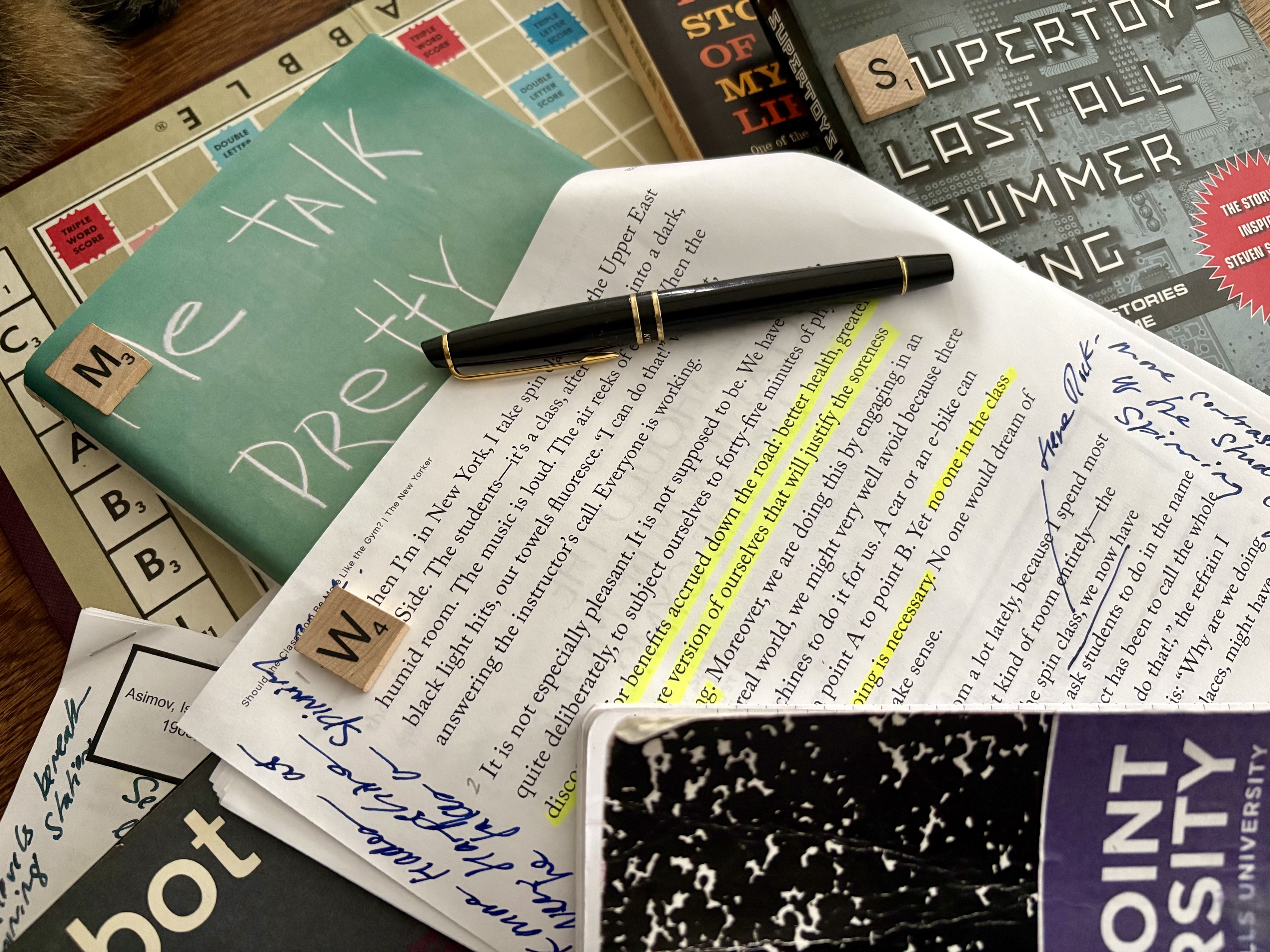
Monday in class you will plan and compose a midterm reflective essay that documents your work in the first half of the semester, focusing on two or three assignments or aspects of the course that have contributed to your development as a writer and a student. Since you have already written a reflection devoted solely to your literacy narrative, your midterm reflection should focus primarily on other assignments or aspects of the course. One of the requirements of the reflection is incorporating a relevant quotation from Dan Rockmore’s essay “Should the Classroom Be More Like the Gym?” Before Monday’s class, determine what phrase, clause, or sentence you will quote, and draft a sentence in your journal that introduces the quotation with a signal phrase and follows it with a parenthetical citation.
Directions
To comply with the requirements for your reflection assignment, you will need to complete the planning exercise that follows. In class, you will not be permitted to refer to this blog post or any other online resources. You will need to have all the necessary citation information written longhand in your journal.
- Review “Should the Classroom Be More Like the Gym?” and number its paragraphs.
- Choose a phrase, clause, or sentence pertinent to your experience as a student in English 1103. What you select may remind you of a particular assignment or activity in the course, or may speak to your experience with or concerns about A.I.
- After you have chosen a passage, compose a signal phrase in your journal to introduce the quotation. (See the examples below.) Many academic writing assignments, including most that follow MLA style, require a signal phrase. A quotation that lacks one is considered a dropped quotation.
- Follow your signal phrase with the quotation, and follow the quote with an MLA-style parenthetical citation. (See the examples below.)
- Optional: Below your sentence, write the MLA-style work cited entry for Rockmore’s essay. You will not need to refer to your journal for that information because it’s included on your copy of the essay. In class, when you write your work cited entry, you can refer to the one on your handout. Why write a work cited entry in my journal if I’m not required to? you might ask. As Rockmore notes, “the exercise is the point” (par. 15).
Examples
- In “Should the Classroom Be More Like the Gym?” Dan Rockmore observes, “If the process is the goal, we should be focussing on how to create classrooms that make the process worth doing for its own sake” (par. 8). That aim underlies my classes’ varied structure. Alternating close reading of texts, drafting, and revising, with frequent short exercises, small-group collaboration, and weekly Scrabble play provides students with a variety of opportunities to hone their skills as writers, readers, and thinkers. And the range of assignments and activities reduces the risk of the monotony that can plague a seventy-minute class period.
- In “Should the Classroom Be More Like the Gym?” the author observes, “If the process is the goal, we should be focussing on how to create classrooms that make the process worth doing for its own sake” (Rockmore, par. 8). That aim underlies my classes’ varied structure. Alternating close reading of texts, drafting, and revising, with frequent short exercises, small-group collaboration, and weekly Scrabble play provides students with a variety of opportunities to hone their skills as writers, readers, and thinkers. And the range of assignments and activities reduces the risk of the monotony that can plague a seventy-minute class period.
The two examples above are very similar, not identical. The first one names the author, so only the abbreviation par. and the paragraph number appear in the parenthetical citation. The second does not name the author, so his last name and a comma precede the paragraph number in the parenthetical citation.
Notice how the two sentences that follow the quotation demonstrate the relevance of Dan Rockmore’s ideas to my own teaching philosophy and practices. If I were to continue the reflection that I began in the examples above, I would offer examples to support my claim that such activities as close readings of essays and short stories and Scrabble play develop students’ analytical skills.
Note that Rockmore’s spelling of focusing as focussing with two s‘s is an acceptable variation, but the single-s spelling is preferable in formal writing.
You are welcome to cite one or more additional readings in your reflection. If you plan to do so, repeat the steps in the directions above with your chosen essay, short story, or chapter. In your journal, make note of the examples in the September 8 class notes. Pay close attention to the differences between parenthetical citations for sources with page numbers and those without. You do not need to write the work cited entry in your journal because it’s included on your copy of the reading. In class, when you write your work cited entry, you can refer to the one on your handout. Note the hanging-indent style of the work cited entries, which is the opposite of an MLA-style paragraph.
Constant Consonants
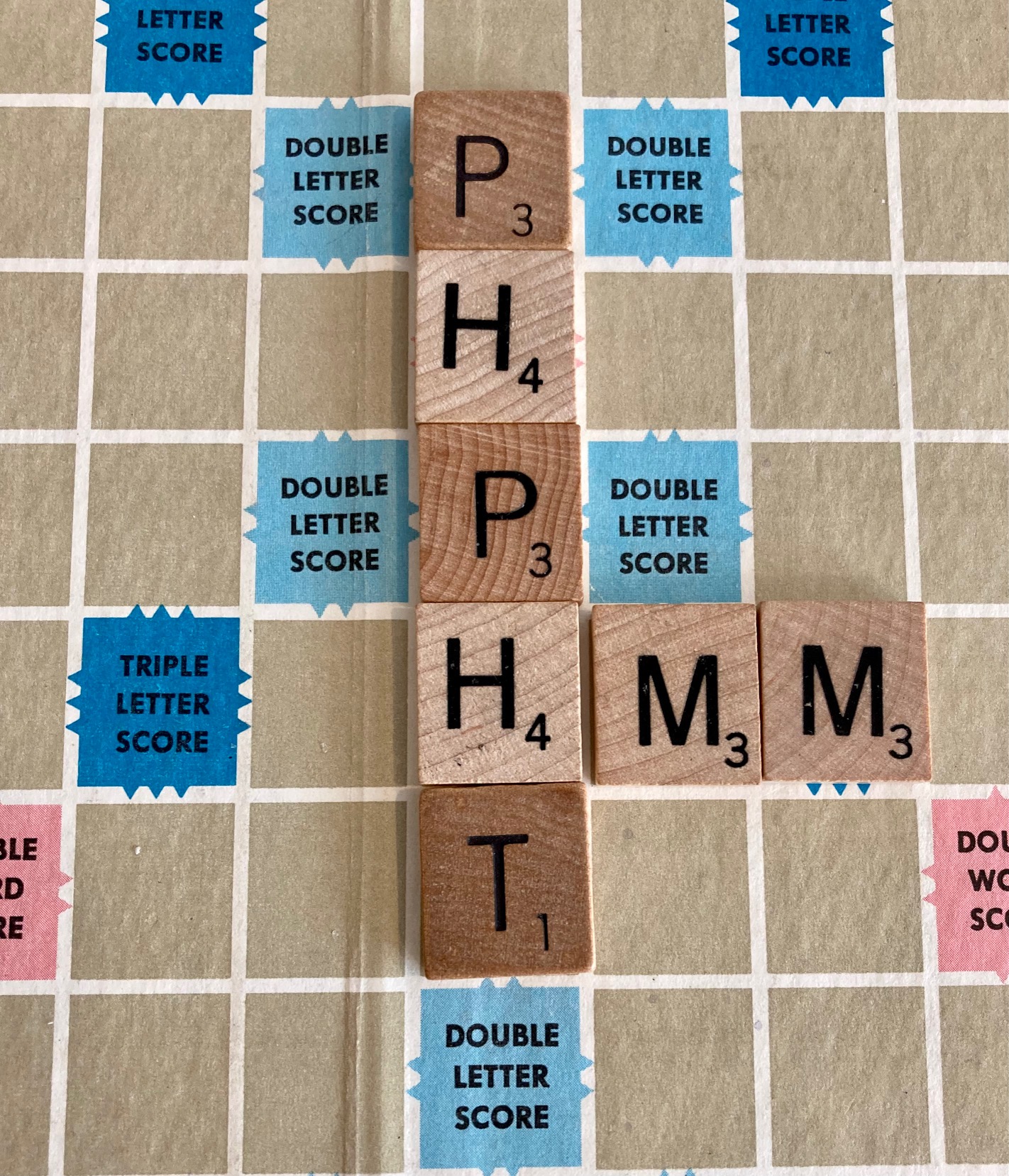
In Scrabble, if you think it’s impossible to make a play with the tiles on your rack, you can forgo a turn and swap tiles, all seven or fewer. If you think losing a turn and swapping tiles is inevitable, examine the board closely to determine whether a one- or two-letter low-point play is an option. Often it is. If not, and the problem you face is a rack without vowels, one of the words in today’s list might be an option.
- brr: used to indicate that one is cold
- crwth: an ancient stringed instrument (pl. -s)
- cwm: a cirque (a deep, steepwalled basin on a mountain, pl. -s, prounounced to rhyme with “boom”)
- hm: used to express thoughtful consideration (also “hmm“)
- mm: used to express assent or satisfaction
- nth: describing an unspecified number in a series
- phpht: used as an expression of mild anger or annoyance (also “pht“)
- psst: used to attract someone’s attention
- sh: used to urge silence (also “shh” and “sha“)
- tsk: to utter an exclamation of annoyance (-ed, -ing, -s)
- tsktsk: to “tsk” (-ed, -ing, -s)
Next Up
In class on Monday, you will write your midterm reflection. Review the guidelines in today’s blog post to prepare.
Coming Soon
On Wednesday, September 30, I will return your handwritten drafts (with my notes), and you will have the class period to begin revising on your laptops. Because the first week of October is Fall Break, you have two additional weeks to revise before you submit your analysis to Blackboard and publish it on WordPress. The due date for your revised analysis is Wednesday, October, 14 (before class). The deadline is Friday, October 16 (before class).


