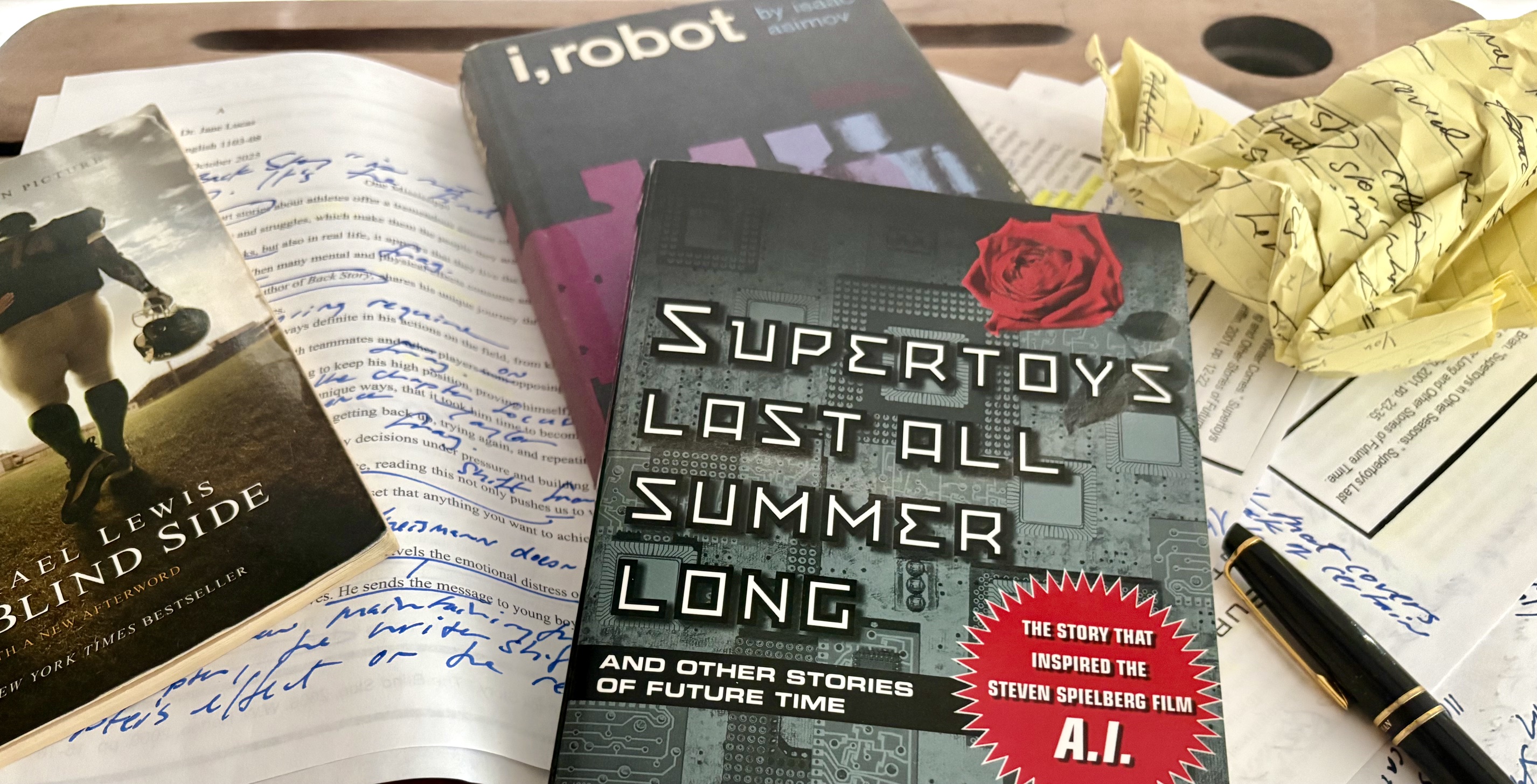
Yesterday in class, you and your classmates collaboratively reviewed the student essay “One Mississippi” and used the analysis revision guidelines for the grade you assigned to it. Afterward, we examined “One Mississippi” paragraph by paragraph. The matters of content and form addressed are included in the lists that follow.
“One Mississippi”: Notes on Content
- In the first paragraph, the writer generalizes about sports rather than pinpointing the subject, implies the chapter is a work of short fiction, and incorrectly identifies the author as Joe Theismann.
- Instead of presenting a claim, the thesis describes the chapter, but it’s not an accurate description. “Back Story”‘s central figure isn’t Joe Theismann; it’s Lawrence Taylor.
- In the second paragraph, the writer offers more generalizations about sports and shifts the focus away from the chapter itself to its effects on readers.
- The writer turns back to Theismann, offering an assessment of his mindset that isn’t warranted by anything in the chapter. He mentions Theismann’s “terrible state” (par. 3) but doesn’t specify its cause, which is dramatized in the opening of the chapter.
- In the third paragraph, the writer lets readers see Michael Lewis’s words for the first time, but doesn’t introduce the quotation or demonstrate its significance.
- The writer mentions Lewis’s “inclusion of Mississippi” (par. 4), but doesn’t provide evidence to support his claim that the word “indicates where the story is heading and the tone” (par. 4).
- In the final paragraph, the writer offers more generalizations rather than employing one of the effective strategies for conclusions, including these: (1) offering an insight about the text or an additional quotation from it, (2) revisiting the thesis without stating it verbatim, and (3) pointing to the broader implications of the analysis.
“One Mississippi”: Notes on Form
- The analysis contains three sentence fragments: “When many mental . . . ” (par. 1), “Continuous days spent . . . ” (par. 2), and “Making speedy decisions . . . ” (par. 2).
- The writer repeatedly misspells Joe Theismann’s last name (pars. 1, 3, and 5).
- The writer refers to Theismann as Joe rather than by his last name (par. 5). In formal writing, refer to people by first and last name on first reference. On subsequent references, refer to them by last name. Fictional characters are an exception to that rule. Refer to them by first name after the first reference unless they are called by their last names (as Donovan and Powell are in Isaac Asimov’s “Runaround”).
- The title of the chapter is italicized and enclosed in quotation marks (pars. 1, 4, and 5). In MLA style, chapter titles are enclosed in quotation marks, not italicized.
- The title of The Blind Side isn’t italicized (par. 4).
- The quotation from “Back Story” isn’t introduced with a signal phrase.
- The parenthetical citation doesn’t include the page number. Instead, it incorrectly includes the paragraph number, which should only be included if the source lacks page numbers.
- The work cited entry includes “Chapter one” (it shouldn’t) and omits the period required at the end.
As you continue to revise your analysis, review the lists above to minimize your chances of commiting the same errors.
Preparing for Your Analysis Reflection
Tomorrow in class, you will compose a reflective essay that documents the process of planning, drafting, and revising your analysis. In your reflection, you will include one quotation, which you will introduce with a signal phrase and follow with a parenthetical citation.
To comply with the requirements for your reflection assignment, you will need to complete the planning exercise that follows. In class, you will not be permitted to refer to this blog post or any other online resources. You will need to have all the necessary information written longhand in your journal.
Directions
- Review the story or stories that serve as your subject of your analysis, and identify the line that led you to choose that story (or story series) as your subject. The line doesn’t have to be one that you quote in your analysis, but it should be the one that piqued your interest in the narrative.
- Once you have identified that line, draft in your journal a passage for your reflective essay that introduces the quotation with a signal phrase and follows it with a parenthetical citation.
- Following the parenthetical citation, include a transitional phrase, clause, or sentence that logically connects those words from the story to your analysis. (See the example below.) After you draft your passage, keep in mind the questions you asked of the excerpts you examined in class on Monday, and ask similar ones of your own writing: Do I provide sufficient context for the quotation? Do my words that follow the quotation connect logically to Aldiss’s or Asimov’s? Do I demonstrate the quotation’s significance to the development of my analysis?
- Optional: Compose a work cited entry or works cited entries for your reflection. In class, you will not need to refer to your journal for that information because the MLA -style entry is included on Asimov’s and Aldiss’s stories. Keep in mind, however, that those entries are single-spaced and yours should be double-spaced. For additional examples of works cited entries for the stories, see the October 1 class notes.
Example
When I reread “Runaround,” and noticed the narrator’s reference to Speedy as “the errant robot” (49), I recalled my initial reaction to some of the early covers for I, Robot. At the time, I viewed their similarity to medeival knights as a simple matter of marketing. But later I noted how Asimov’s descriptions of Donovan and Powell riding the older robots repeatedly likened the machines to horses. Those images, the parallels between the Three Laws of Robotics and the code of chivalry, and the descriptor errant provided the foundation for my analysis.
Submitting Your Analysis Revision
The due date for your revised analysis is tomorrow, Wednesday, October 14 (before class). If you do not remember how to submit an MS Word file or PDF to Blackboard or publish a blog post on WordPress, review the step-by-step directions in the September 8 class notes.
Remember that your analysis blog post needs to include both a picture that documents your writing away from the screen (longhand) and an embedded link. If your analysis focuses on the fiction of Brian Aldiss, I recommend embedding a link to his official website or to “Supertoys Last all Summer Long” on Wired magazine’s website. To view those sites, click on the links in the previous sentence. If your analysis focuses on “Runaround,” I recommend embedding a link to a PDF of the story posted by Steven J. Miller, professor of mathematics at Williams College. To view that link, click on the story title in the previous sentence.
Next Up
In class tommorow, you will compose your reflective essay focusing on the process of planning, drafting, and revising your analysis. If you are still in the process of completing your essay on Wednesday (since you have until Friday morning’s hard deadline to post it without a late penalty), your reflection will address your work in progress. Follow the guidelines included above to ensure you will be prepared to complete all requirements for your reflection.

