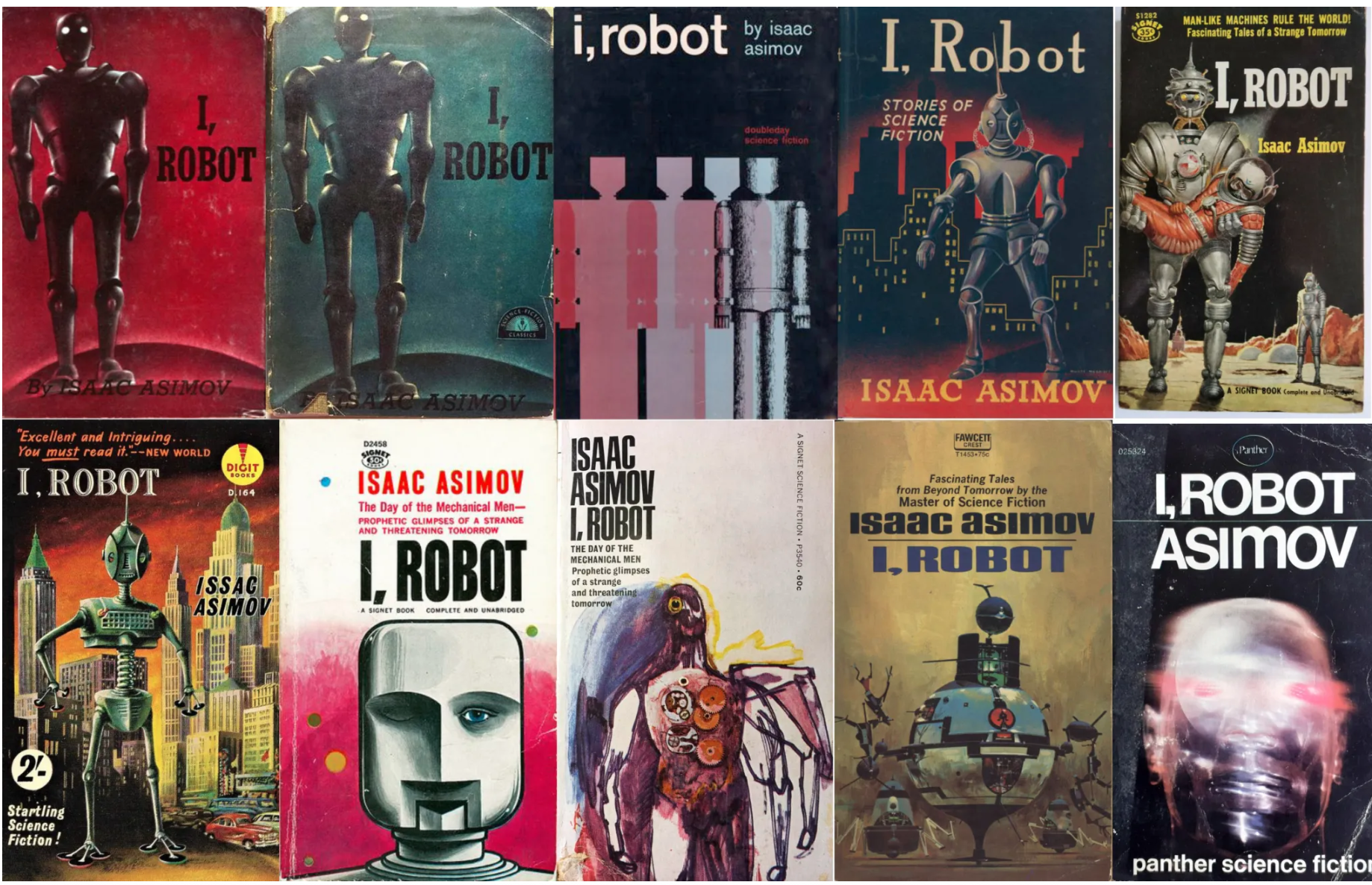
Tomorrow in class, you will begin drafting your analysis, which will focus on Isaac Asimov‘s short story “Runaround, one or more of Brian Aldiss‘s supertoys stories, or “Runaround” in conjunction with one or more of the covers of I, Robot pictured above.
In the early stages of your work, pay attention to the details that interest you. Don’t concern yourself with developing a thesis before you begin writing. The preliminary writing itself is a step that will lead to your thesis and the textual evidence that will support that claim.
One of the details you and your classmates addressed in your writing on Monday may figure in your analysis. Review those prompts and your responses, included below. Could any of them serve as a building block for your analysis?
Below are the prompts from Monday’s class exercise, along with your responses. The groups’ statements appear in bold, followed by my notes.
Although “Supertoys When Winter Comes” and “Supertoys in Other Seasons” are sequels to “Supertoys Last All Summer Long,” Aldiss’s first supertoys story was published as a stand-alone work of fiction in Harper’s Bazaar magazine in December 1969. (The second and third stories were first published in 2001, in the collection Supertoys Last All Summer Long and Other Stories of Future Time, as never-before-seen sequels to the original.) If you chose to analyze “Supertoys Last All Summer Long” as a stand-alone story, what detail would you be certain to include?
- Near the end of “Supertoys Last All Summer Long” by Brian Aldiss, the image of “artificial sunlight [. . .] growing long and golden across the lawn” (10) shows evidence of more than just the child robots not being real. It also points to a trend: Everyday things taken for granted may not be real in the future. Note: If you choose to focus on Aldiss’s “Supertoys Last All Summer Long” as a stand-alone story, you might explore how that image of the virtual sunlight and other illusions contrast with the depiction of the real world of the story. How have technological advancements impacted the environment and the people in it?
- Towards the middle of “Supertoys Last All Summer Long,” Monica asks, “‘Why can’t we communicate?” to which Teddy responds, “‘Because David’s upstairs'” (6). That exchange captures how the relationship between Monica and David is being processed through Teddy. Note: The group’s statement does not convey why Teddy’s role as a go-between is significant. If you choose to focus solely on Aldiss’s first story, you might consider the nature of communication between Monica and the supertoys or between the two supertoys themselves.
Where and how is one or more of Asimov’s Three Laws of Robotics evident in the actions of David, Teddy, or Jules, the serving-man, or where and how do the actions of one of those characters defy one of the laws?
- Near the end of “Supertoys When Winter Comes,” David, in a fit of despair, “had struck the house’s control centre” (21). That led to the house disappearing, which causes a dangerous situation for Monica to be in, breaking the first of the Three Laws of Robotics. Note: David’s violation of the first law causes more than the disappearance of the virtual facade of the Swinton’s apartment, the illusion of a Georgian Mansion. Striking the house’s control centre demolishes the Swintons’ actual apartment, apparently leaving Monica Swinton, Jules, the serving-man, and Teddy in the rubble. If you address one or more of the Three Laws of Robotics in your analysis, the first mention should be followed by a quotation or paraphrase of that law with a parenthetical citation for Isaac’s Asimov’s story: (Asimov 51).
- In “Runaround,” one of The Three Laws of Robotics states, “One, a robot may not injure a human being, or through inaction, allow a human being to come to harm” (Asimov 51). David breaks that law in “Supertoys When Winter Comes” when he goes rogue, and it leads to his Mom’s passing: “David struck the house’s control centre, wrenching it from the wall in a fury of pain and despair. Everything stopped playing”(21). That allows the readers to see that nothing is left except David. Note: The group states what David’s actions allow the readers to see, but their statement doesn’t convey the implications of that action. What does his violation of the first law indicate about the laws, the robots, and/or the humans they serve?
Henry Swinton’s words about obesity and malnutrition in “Supertoys Last All Summer Long” are repeated by him, almost verbatim, in “Supertoys When Winter Comes” and the Crosswell Tape and weight gain are also mentioned in “Supertoys in Other Seasons.” How are those issues linked to technology in Aldiss’s fictional world?
- In Brian Aldiss’s “Supertoys Last All Summer Long,” Henry Swinton states, “Obesity’s our problem, not malnutrition” (3). That observation indicates how becoming reliant on technology leads to unique problems that are not typically faced in the modern day. Note: The group’s statement indicates a contrast between the advances in technology in Aldiss’s fictional world and real-world advancement. In both classes, however, we considered the similarities between Synthank’s Crosswell Tape–the company’s leading product–and the synthetic peptides of GLP-1 drugs.
- Throughout Aldiss’s story “Supertoys When Winter Comes,” he connects the conflicts of obesity and malnourishment with technology by mentioning the “safe parasitic worm [that] enables anyone to eat up to one hundred per cent more food and still keep his or her figure” (18). Aldiss continuously references Crosswell Technology to emphasize how technology plays a role in the pursuit of unrealistic beauty standards and issues in population and malnutrition within all three stories. Note: The group’s statement essentially rephrases the prompt rather than moving from observation to analysis. The group introduces the idea of body image, but doesn’t convey how that preoccupation with appearance is linked to Henry Swinton’s Synth company or how the conflicting issues of obesity and malnutrition correlate with technological advancement.
In “Supertoys When Winter Comes,” Monica Swinton tells David he’s “only a little android” (20). Where in the story do her words or actions seem to contradict that assertion?
- In “Supertoys When Winter Comes,” Monica Swinton faces terror when her android friend dies. She says, “Oh God! It’s Jules. Poor Jules! He was a friend to me” (20). That contradicts her feelings about David because Jules is an android, but Monica valued him as more than that. Note: The group does mention that Jules is the Swintons’ serving-man, an important detail because his function in the household is different from the supertoys.’ Jules’s role is to serve, but Monica thinks of him as a friend. What does that reveal about her ambivalence regarding AI?
- Near the beginning of “Supertoys When Winter Comes,” Monica, says to David and Teddy, “Come in now, children. Go upstairs and play”(14), demonstrating her connection to the boy and bear, the other “little android” (20), as she mourns the loss of her human child. Note: In your analysis, if you choose to address the inconsistencies in Monica Swinton’s exchanges with the androids, you might consider how her desire for a human child in the first story and the death of that child, revealed in the second story, may affect her words and actions.
“Supertoys in Other Seasons” begins in Throwaway Town, which the narrator calls “the land of the obsolete” (24). Who besides the mechanicals becomes obsolete, and who or what leads to his demise?
- In “Supertoys in Other Seasons,” there is a parallel between the mechanicals being trashed in “the land of the obsolete” and how Henry’s life values have become obsolete as well. As Henry became increasingly greedy, his work decreased. Henry gets pushed out of the company and is made obsolete by the robot he created. Henry not only loses his company, he loses his wife and his son too. Henry’s life becoming obsolete leads Henry to remember that family is the most important thing and that David is family. That is further demonstrated when Henry asks, “David? Are you David Swinton?” (31). His words show Henry still claims ownership of David and shows that while everything else was lost, David never left. Note: The group refers to Sam Savvy as a robot, but there is no indication that he/it is mobile. Sam Savvy, the Supersoftputer Mk. V. that essentially runs Worldsynth-Claws, may be a form of AI more akin to the agents of Copilot, ChatGPT, and Claude. Also, the group writes that David “never left,” but he does leave the crumbled remains of the Swinton’s apartment for Throwaway Town. Later, Henry finds him.
- In “Supertoys in Other Seasons,” Henry says, “My ambition got the better of me . . . my life is a complete cock-up” (33), showing how Henry becomes obsolete and how he leads himself to his demise. Note: The group does not mention that when Henry Swinton is forced into retirement by Worldsynth-Claws, it is Sam Savvy, the Supersoftputer Mk. V.–a product of Henry Swinton’s own company–that dismisses him. It is not only the decisions Henry makes but also his unwelcome proposals (decisions he isn’t permitted to make) that lead to his downfall.
In your brainstorming exercise last Wednesday, all of your groups developed analysis prompts that featured humans’ relationships with robots and the impact of artificial intelligence. Whatever you choose as the focus of your analysis, those two ideas are ones that you will be able to address in your conclusion. There, in your final paragraphs, you can express what your observations about the story (or stories) reveal about humans’ relationships with robots and the impact of A.I.
If your analysis focuses on “Runaround” and I, Robot cover art, you are also welcome to incorporate a study of one or both of the I, Robot covers pictured in the September 14 blog post: the 2020 Del Rey cover designed by Charles Brock and the 2004 Bantam cover designed by Jamie S. Warren Youll.
Seeing Letters and Words Anew
Seeing anew–which means seeing in a different, fresh, or modified way–is an important practice when you are studying your options for Scrabble play or analysis. When you play Scrabble, don’t hold some of the tiles in your hand. Keep all seven on the rack so your teammate can see them. And rearrange them as you consider options. Leaving the letters in one order may lead you and your teammate unable to see other possibilities (such as evil, which the second team missed in the September 4 game).
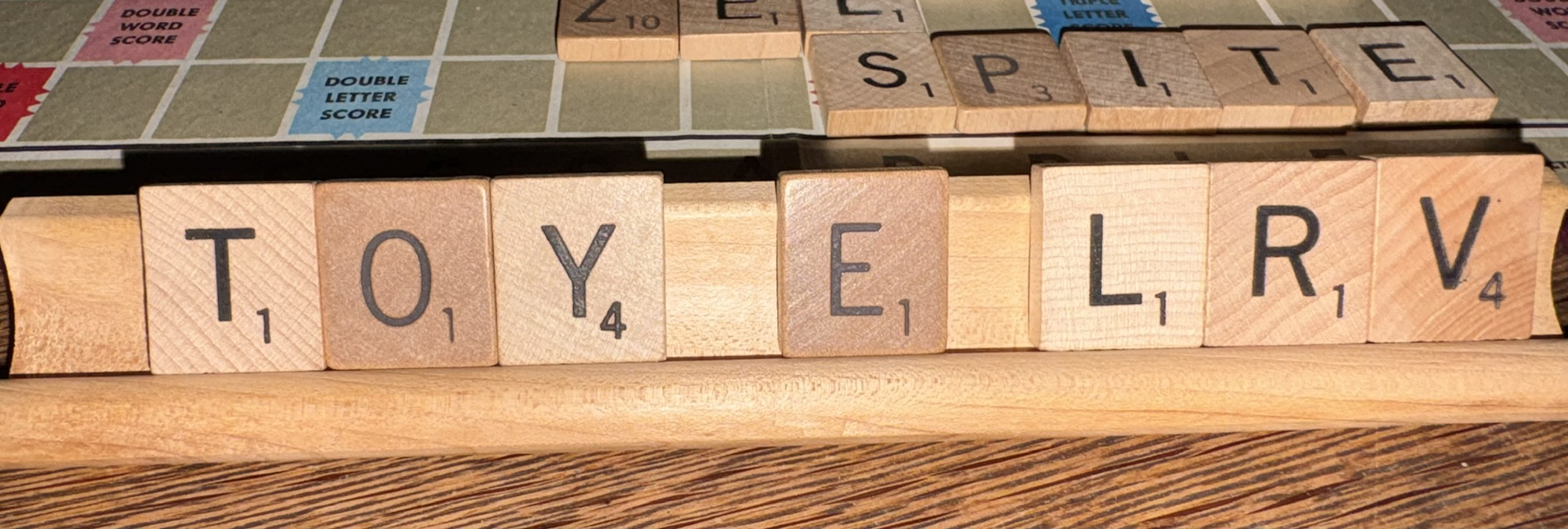
On the rack above, I have spelled a word, toy, as many players will when they first recognize a word among the seven letters. But leaving a word on the rack may prevent you from seeing other possibilities: lover, over, rove, toyer, very, vet, and one that’s far more valuable. What is it? See the end of this post for the answer.
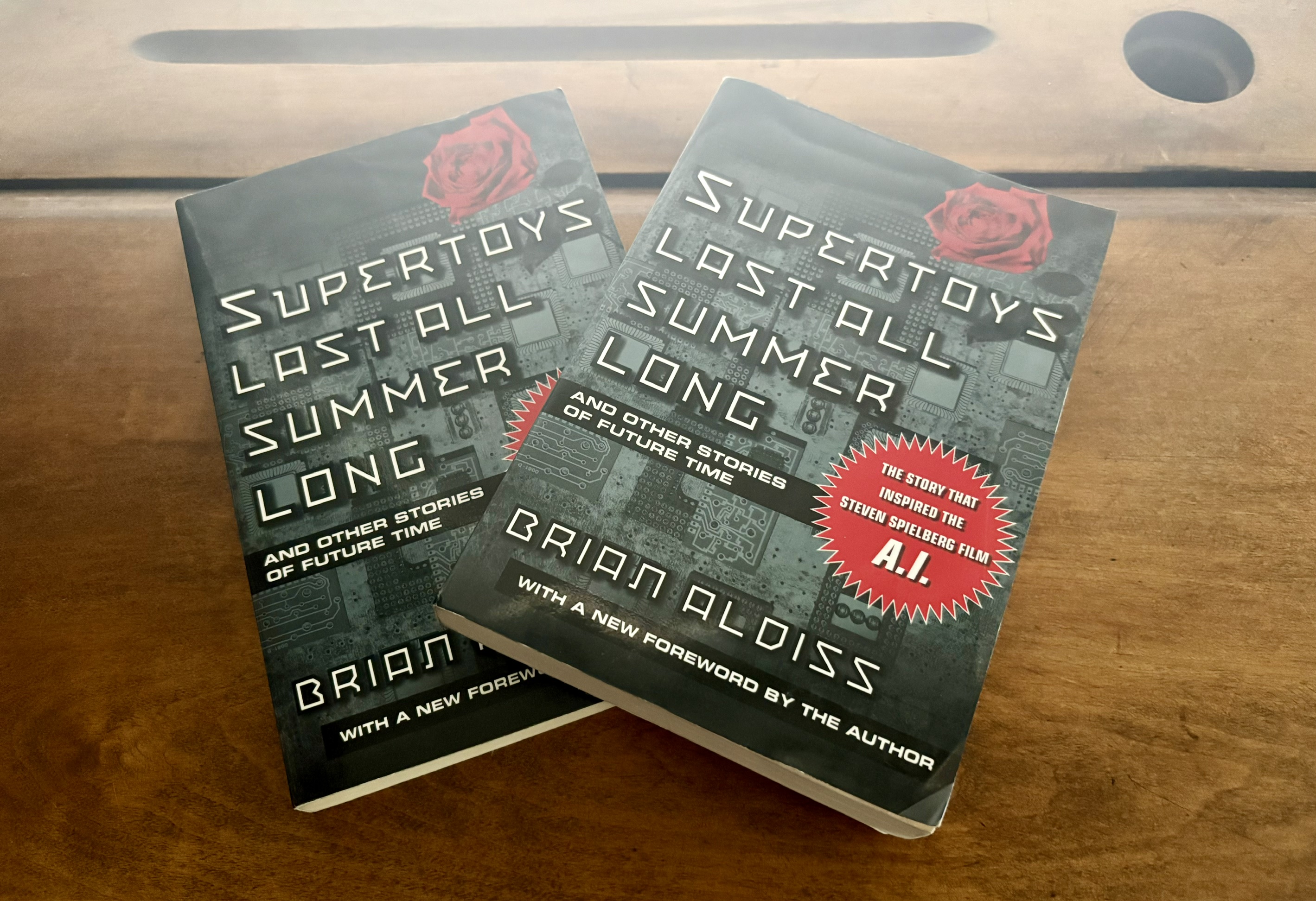
In tomorrow’s class drawing, you will have the chance to win one of the copies of Brian Aldiss’s short story collection pictured above.
Next Up
On Wednesday, we will briefly examine some additional details in Asimov’s and Aldiss’s stories. Afterward, you will begin drafting your analyses longhand. Next Wednesday, September 30, I will return your drafts, and you will have the remainder of the class period to begin revising on your laptops. Because the following week is Fall Break, you will have two additional weeks to continue revising before posting to Blackboard and WordPress. The due date for your analysis is Wednesday, October 14, before class; the hard deadline is Friday, October 16, before class.
Answer
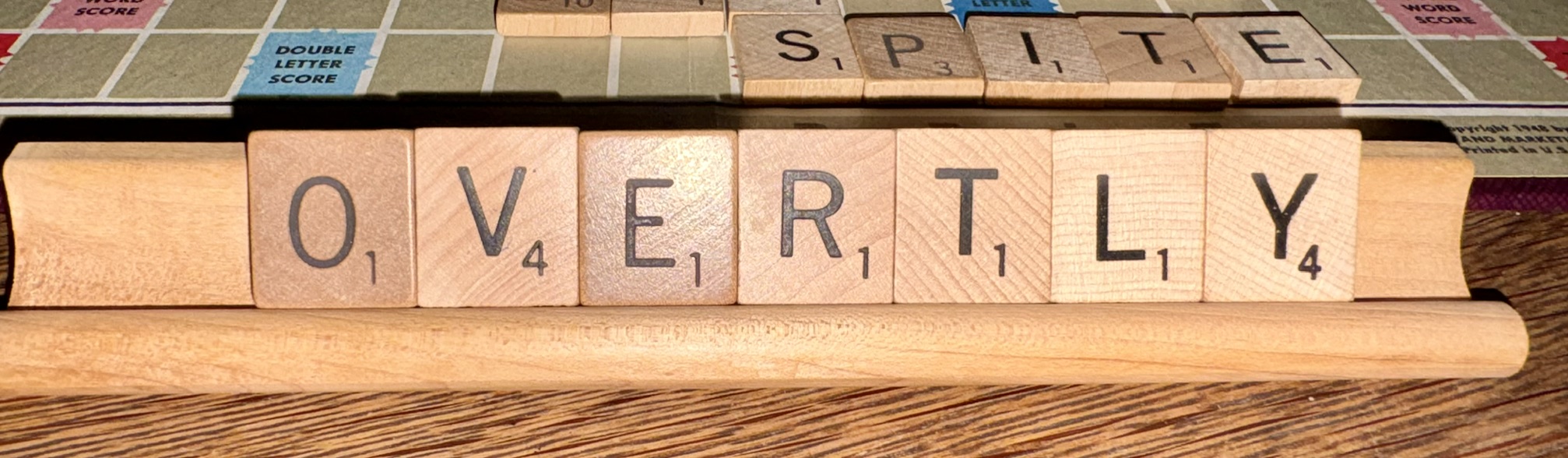
Repeatedly rearranging the letters on your rack can lead you to discover new potential plays. Looking beyond toy and finding overtly could mean a play of more than fifty points if you were able to play all seven letters at once.
Just as rearranging the letters on your rack enables you to see them anew, rereading the story that’s the subject of your analysis and posing questions–for instance, What else might that detail indicate?–allows you to see the words and phrases anew and can lead you to more material for your analysis, details that had previously escaped your notice.

